Feedback control (closed loop)
also: closed-loop control · open-loop vs closed-loop
Measuring what a system is actually doing and continuously correcting the input so the output tracks a target, instead of acting blind.
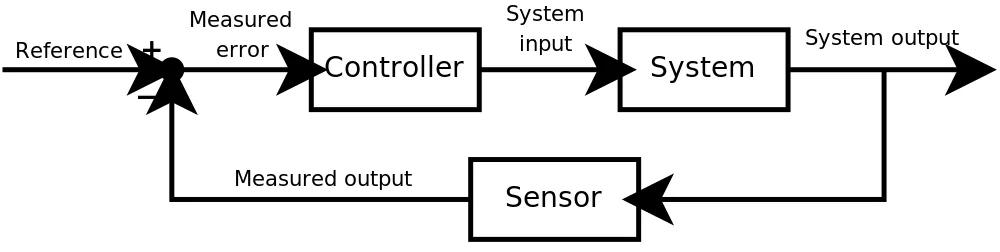
An open-loop system sends a command and hopes for the best: a toaster timer, a fan set to a fixed speed. A closed-loop (feedback) system measures the result (temperature, speed, position, pressure), compares it with the target (the setpoint), and adjusts the actuator based on the difference (the error). Thermostats, cruise control, and most motor controllers are feedback systems.
Feedback is what lets a product hold its spec despite things you can't control: a door left open, a battery sagging, a heavier load, part-to-part variation from the factory. It also brings new risks. A loop tuned too aggressively oscillates or goes unstable, and a slow or noisy sensor limits how good the control can ever be.
Where it bites: the sensor becomes part of the product's critical path. Its accuracy, response time, placement, and failure modes set the ceiling on performance, and a feedback loop with a failed sensor can drive an actuator hard against its limit. Plan for sensor fault detection and a defined safe fallback behavior.
Founder takeaway
Ask what is being measured, how often, and what the product does when that measurement is wrong or missing.